



An NTC Temperature Sensor probe is a temperature measurement device based on an NTC thermistor(Negative Temperature Coefficient).It works by detecting temperature changes through variations in electrical resistance and converting them into accurate temperature readings.
Because of its high sensitivity,fast response time,and low cost,it is widely used in home appliances,automotive systems,industrial equipment,HVAC systems,and electronic devices.
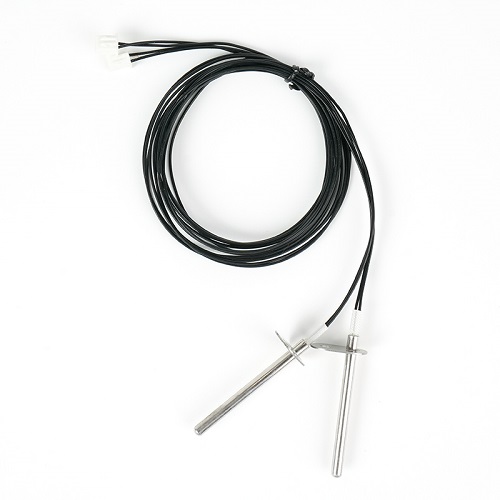
Working Principle of NTC temperature sensor
The core principle of an NTC sensor is simple:
When temperature increases→resistance decreases
When temperature decreases→resistance increases
This predictable inverse relationship allows electronic circuits to calculate temperature accurately by measuring resistance changes.
How NTC Temperature Sensor Probe Works(Step-by-Step)
1.Temperature Contact
The probe is placed in air,liquid,or attached to a surface such as a motor,pipe,or battery to monitor temperature changes.
2.Resistance Change
Inside the probe,the NTC thermistor reacts to temperature:
Higher temperature→electrons move more freely→resistance decreases
Lower temperature→electron movement slows→resistance increases
3.Signal Measurement
A small current is passed through the thermistor.The system measures voltage changes and calculates resistance using electrical principles.
4.Temperature Conversion
The resistance value is converted into temperature using a calibrated resistance–temperature curve stored in the control system.This curve is nonlinear and requires precise calibration.
5.System Output
The final temperature signal is sent to a controller(such as MCU,thermostat,or BMS),which may trigger actions like cooling,heating,or safety protection.
Structure of an NTC temperature probe
A typical probe includes:
NTC thermistor element–sensing core
Protective housing–stainless steel,epoxy,or plastic casing
Lead wires–transmit electrical signals
Insulation layer–protects against moisture,vibration,and interference
This structure allows reliable operation even in harsh environments such as water,oil,or industrial machinery.
Key Features
High Sensitivity
Detects even small temperature changes accurately.
Fast Response
React quickly to environmental temperature fluctuations.
Compact Design
Suitable for tight or embedded installations.
Cost-Effective
Provides accurate measurement at low cost.
Applications
NTC temperature probes are widely used in:
Home appliances(air conditioners,refrigerators,water heaters)
Automotive systems(engine and battery temperature monitoring)
Industrial equipment(ovens,motors,compressors)
Medical devices(temperature monitoring systems)
Electronics(battery protection and thermal control systems)
Advantages and Limitations
Advantages
High accuracy in normal temperature ranges
Fast response time
Easy integration into electronic systems
Long service life
Limitations
Nonlinear resistance–temperature relationship
Limited extreme high-temperature range
Requires calibration for precision applications
FAQ
1.What is an NTC temperature sensor probe used for?
It is used to measure temperature in systems such as home appliances,automotive electronics,industrial machines,and battery management systems.
2.Why is it called an NTC sensor?
NTC stands for Negative Temperature Coefficient,meaning resistance decreases as temperature increases.
3.How accurate is an NTC temperature sensor?
Depending on design and calibration,accuracy can typically range from±0.1°C to±1°C in common applications.
4.Can NTC temperature probes be used in water?
Yes.Waterproof stainless steel NTC probes are designed specifically for liquid temperature measurement.
5.How long does an NTC sensor last?
High-quality NTC probes can last several years or even longer if used within their rated temperature range.
6.Do NTC sensors need calibration?
Yes.For high-precision applications,calibration is required because the resistance–temperature curve is nonlinear.
