



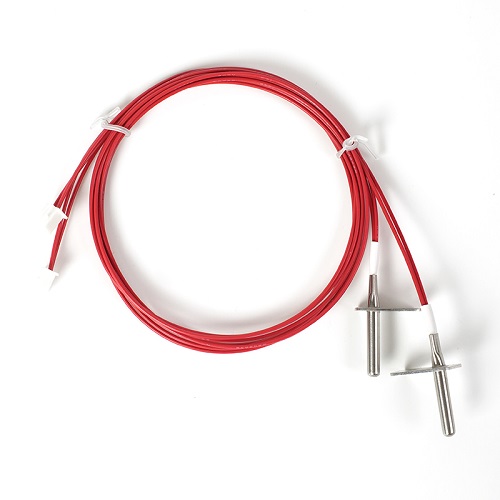
An NTC Temperature Sensor Probe is a temperature-sensing device that uses an NTC(Negative Temperature Coefficient)thermistor to measure temperature.The resistance of the NTC thermistor decreases as the temperature increases,making it a highly sensitive and cost-effective solution for temperature monitoring and control applications.
NTC temperature sensor probes are widely used in household appliances,industrial equipment,automotive systems,medical devices,HVAC systems,and consumer electronics due to their accuracy,fast response time,and reliability.
What Does NTC Mean?
NTC stands for Negative Temperature Coefficient,which means the electrical resistance of the sensor decreases as temperature rises.
For example:
Temperature Resistance
0°C High
25°C Medium
100°C Low
This predictable relationship between temperature and resistance allows electronic circuits to accurately calculate temperature values.
What Is an NTC Temperature Sensor Probe?
An NTC temperature sensor probe consists of:
An NTC thermistor element
Lead wires
Protective housing or probe casing
Insulation materials
Connector or terminal
The thermistor is usually encapsulated inside a metal,plastic,epoxy,or stainless-steel probe to protect it from moisture,chemicals,vibration,and mechanical damage.
How Does an NTC Temperature Sensor Probe Work?
The operating principle is based on resistance variation.
Step 1:Temperature Changes
The surrounding environment heats or cools the thermistor.
Step 2:Resistance Changes
As temperature rises:
Resistance decreases.
As temperature falls:
Resistance increases.
Step 3:Signal Measurement
An electronic control circuit measures the resistance value and converts it into a temperature reading.
Step 4:Temperature Control
The measured temperature can then be used to:
Activate cooling fans
Control heaters
Trigger alarms
Protect equipment from overheating
Monitor process temperatures
Key Characteristics of NTC Temperature Sensor Probes
High Sensitivity
NTC thermistors respond quickly to small temperature changes,making them ideal for precise measurements.
Fast Response Time
Their small size allows them to react rapidly to temperature fluctuations.
Excellent Accuracy
Many NTC probes achieve accuracy levels of:
±0.1°C
±0.2°C
±0.5°C
depending on design and calibration.
Compact Design
NTC thermistors are extremely small,allowing integration into tight spaces.
Cost-Effective Solution
Compared to other temperature sensing technologies,NTC sensors are relatively inexpensive while maintaining excellent performance.
Components of an NTC Temperature Sensor Probe
NTC Thermistor Chip
The core sensing element made from semiconductor metal oxides.
Protective Housing
Protects the sensor from environmental conditions.
Common materials include:
Stainless steel
Copper
Brass
Plastic
Epoxy resin
Lead Wires
Transmit resistance signals to the control system.
Connector
Provides easy connection to electronic circuits or control modules.
Common Types of NTC Temperature Sensor Probes
Stainless Steel NTC Probe
Used in industrial and HVAC applications requiring durability and corrosion resistance.
Waterproof NTC Probe
Designed for liquid temperature measurement.
Applications include:
Water heaters
Aquariums
Refrigeration systems
Surface-Mount NTC Probe
Measures the temperature of motors,batteries,and electronic components.
Medical NTC Probe
Used in healthcare equipment requiring high accuracy and rapid response.
Applications of NTC Temperature Sensor Probes
Home Appliances
NTC sensors are commonly found in:
Refrigerators
Washing machines
Coffee machines
Air conditioners
Water heaters
Electric kettles
Automotive Industry
Used for monitoring:
Engine temperature
Battery temperature
Coolant systems
HVAC controls
Industrial Equipment
NTC probes help monitor:
Industrial ovens
Injection molding machines
Boilers
Compressors
Process control systems
Medical Devices
Applications include:
Patient monitoring systems
Diagnostic equipment
Medical incubators
Consumer Electronics
Used in:
Smartphones
Laptops
Power supplies
Battery management systems
NTC Temperature Sensor vs PTC Sensor
| Feature | NTC Sensor | PTC Sensor |
|---|---|---|
| Resistance with Temperature | Decreases | Increases |
| Sensitivity | Higher | Lower |
| Accuracy | Excellent | Good |
| Response Time | Fast | Moderate |
| Cost | Lower | Higher |
| Common Use | Temperature measurement | Overcurrent protection |
NTC Sensor vs Thermocouple
| Feature | NTC Probe | Thermocouple |
|---|---|---|
| Temperature Range | Moderate | Very wide |
| Accuracy | High | Moderate |
| Cost | Low | Higher |
| Response Speed | Fast | Fast |
| Signal Output | Resistance | Voltage |
| Best For | Precise temperature control | Extreme temperatures |
Advantages of NTC Temperature Sensor Probes
Precise Temperature Measurement
Provides highly accurate readings over a defined temperature range.
Reliable Performance
Maintains stable operation over long periods.
Easy Integration
Compatible with most electronic control systems.
Low Power Consumption
Requires very little electrical power.
Wide Range of Designs
Available in numerous probe sizes and housing materials.
Limitations of NTC Temperature Sensor Probes
While highly effective,NTC probes have some limitations:
Limited high-temperature range compared to thermocouples
Nonlinear resistance-temperature relationship
Requires signal conversion circuitry
May require calibration for precision applications
FAQ
What is an NTC temperature sensor probe used for?
It is used to measure and monitor temperature in appliances,industrial equipment,vehicles,medical devices,and electronic products.
Why is it called NTC?
NTC stands for Negative Temperature Coefficient,meaning resistance decreases as temperature increases.
Are NTC sensors accurate?
Yes.Many NTC probes provide accuracy within±0.1°C to±0.5°C depending on design and calibration.
Can NTC probes be used in water?
Yes.Waterproof NTC probes are specifically designed for liquid temperature measurement.
How long do NTC temperature probes last?
High-quality NTC probes can operate reliably for many years when used within their specified temperature range.
