



An NTC thermistor probe is one of the most widely used temperature sensing components in industrial equipment,HVAC systems,automotive electronics,medical devices,and household appliances.Due to its high sensitivity,fast response time,compact size,and cost-effectiveness,NTC Temperature Sensors are an ideal solution for accurate temperature monitoring.
However,choosing the right NTC thermistor probe can be challenging because different applications require different resistance values,temperature ranges,accuracy levels,probe materials,and cable configurations.
This guide explains the key factors you should consider when selecting an NTC thermistor probe for your specific application.
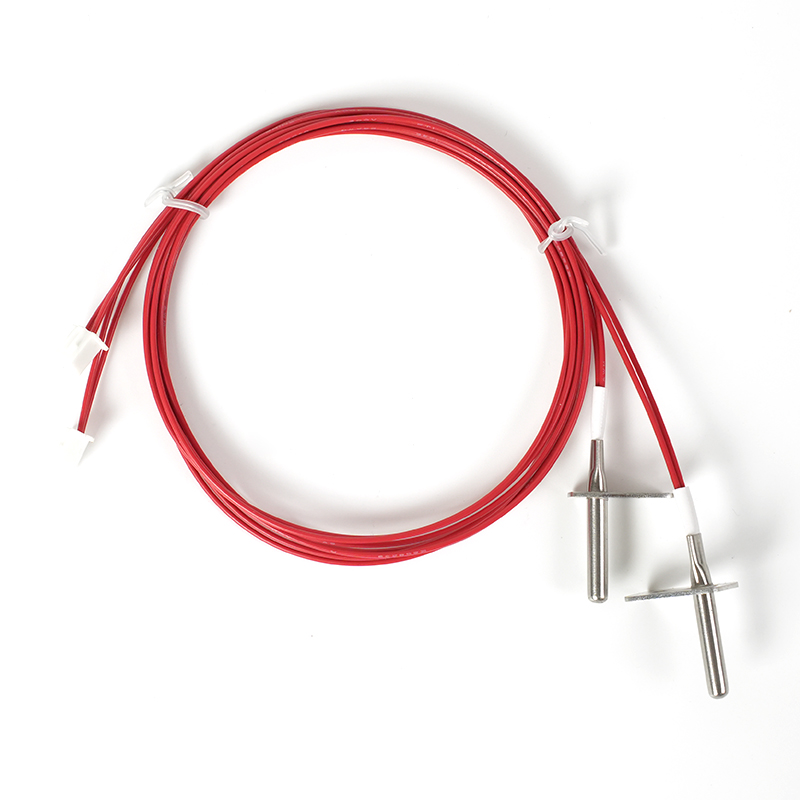
1.Understand the Working Principle of an NTC Thermistor Probe
An NTC(Negative Temperature Coefficient)thermistor is a temperature-sensitive resistor whose resistance decreases as temperature increases.
For example:
At low temperatures→NTC resistance is higher
At high temperatures→NTC resistance is lower
The temperature controller or electronic system measures the resistance change and converts it into a temperature reading.
A typical NTC thermistor probe consists of:
NTC thermistor element
Protective probe housing
Insulated cable
Connector or terminal
Sealing materials
The design of each component affects the sensor’s durability,accuracy,and application suitability.
2.Select the Correct Resistance Value
The resistance value is one of the most important parameters when selecting an NTC thermistor probe.
Common resistance values include:
2KΩNTC probe
5KΩNTC probe
10KΩNTC probe
20KΩNTC probe
50KΩNTC probe
100KΩNTC probe
Among them,the 10K NTC thermistor probe is one of the most commonly used models in HVAC,refrigeration,and temperature control systems.
The resistance value must match the control circuit.Using an incorrect resistance rating may result in inaccurate temperature readings or system errors.
Example:
A refrigeration controller designed for a 10K ntc sensor requires a 10KΩprobe.A 50KΩprobe cannot directly replace it without recalibration.
3.Consider the Temperature Range
Different applications require different operating temperature ranges.
Before selecting an NTC probe,check:
Minimum operating temperature
Maximum operating temperature
Short-term temperature exposure
Typical ranges include:
| Application | Recommended Temperature Range |
|---|---|
| Home appliances | -20°C to +105°C |
| HVAC systems | -40°C to +125°C |
| Automotive applications | -40°C to +150°C |
| Industrial equipment | -50°C to +200°C |
For harsh environments,choose an NTC thermistor probe with high-temperature-resistant materials and protective housing.
4.Choose the Appropriate Probe Material
The probe housing material directly affects durability and response speed.
Common materials include:
Stainless Steel NTC Probe
Advantages:
Excellent corrosion resistance
High mechanical strength
Suitable for liquids and industrial environments
Long service life
Applications:
Water heaters
Boilers
Industrial machinery
Food processing equipment
Plastic NTC Probe
Advantages:
Lightweight
Cost-effective
Good insulation performance
Applications:
Air conditioners
Refrigerators
Consumer electronics
Epoxy-Coated NTC Probe
Advantages:
Compact size
Fast thermal response
Good moisture protection
Applications:
Battery packs
Electronic devices
5.Check Waterproof and Protection Requirements
For environments exposed to moisture,dust,or liquids,a waterproof NTC thermistor probe is recommended.
Important protection ratings include:
IP65:Dust protected and water resistant
IP67:Protection against temporary water immersion
IP68:Suitable for continuous underwater applications
Waterproof NTC probes are commonly used in:
Water dispensers
Swimming pool temperature systems
Refrigeration equipment
Outdoor monitoring systems
6.Select the Right Cable Type and Length
The cable design influences installation flexibility and reliability.
Consider:
Cable Material
Common options:
PVC cable
Silicone cable
PTFE cable
Fiberglass cable
Temperature Resistance
For high-temperature applications:
Silicone cables provide better flexibility
PTFE cables offer excellent heat resistance
Cable Length
Common lengths:
0.5m
1m
2m
Customized lengths
For OEM projects,manufacturers usually provide customized cable specifications.
7.Consider Accuracy and Tolerance
NTC thermistor probes are available with different accuracy levels.
Common tolerances include:
±1%
±2%
±3%
±5%
Higher accuracy sensors are recommended for:
Medical equipment
Laboratory instruments
Precision temperature control systems
Standard industrial applications usually use±1%to±5%tolerance sensors.
8.Evaluate Response Time Requirements
Response time refers to how quickly the sensor detects temperature changes.
Factors affecting response speed include:
Probe size
Housing material
Thermal conductivity
Installation method
Small epoxy NTC probes generally respond faster,while stainless steel probes provide better protection but may respond slightly slower.
Choose based on whether your application prioritizes:
Fast temperature detection
Mechanical protection
Long-term stability
9.Choose a Reliable NTC Thermistor Probe Manufacturer
For OEM and industrial applications,selecting a reliable supplier is essential.
A professional NTC sensor manufacturer should provide:
Customized resistance values
Custom cable lengths
Different probe sizes
Temperature calibration
Quality testing reports
Mass production capability
Before purchasing,check:
Production experience
Quality control system
Product certifications
Customization capability
10.Common Applications of NTC Thermistor Probes
NTC temperature sensor probes are widely used in:
HVAC Systems
Used for:
Air temperature measurement
Evaporator monitoring
Compressor protection
Automotive Industry
Applications include:
Battery temperature monitoring
Engine temperature control
Climate systems
Home Appliances
Used in:
Refrigerators
Washing machines
Ovens
Water heaters
Industrial Equipment
Applications:
Machine temperature monitoring
Automation systems
Process control
FAQ
1.What is the most common NTC thermistor probe?
The 10K NTC thermistor probe is one of the most commonly used models because it provides a good balance between sensitivity,accuracy,and compatibility with many temperature controllers.
2.How do I know which NTC probe I need?
You should consider resistance value,temperature range,accuracy,probe size,cable type,and application environment before selecting an NTC probe.
3.Can an NTC thermistor probe be customized?
Yes.Manufacturers can customize resistance values,cable lengths,connector types,probe materials,dimensions,and temperature ranges according to customer requirements.
4.What is the difference between an NTC probe and an RTD sensor?
NTC probes offer higher sensitivity and lower cost,while RTD sensors such as PT100/PT1000 provide higher accuracy and better long-term stability in industrial applications.
5.Are NTC thermistor probes waterproof?
Many NTC probes are designed with waterproof structures,such as stainless steel housings and sealed epoxy coatings,making them suitable for applications involving moisture or liquids.
