



Accurate temperature measurement is essential in industries such as manufacturing,HVAC,food processing,healthcare,and scientific research.Among the various temperature sensing technologies available today,the PT1000 temperature probe is widely recognized for its high accuracy,stability,and reliability.Whether monitoring industrial equipment or controlling environmental conditions,a PT1000 temperature sensor provides precise temperature readings that help ensure efficient and safe operations.
In this article,we'll explore what a PT1000 RTD probe is,how it works,its key features,applications,and how it compares to other temperature sensors.
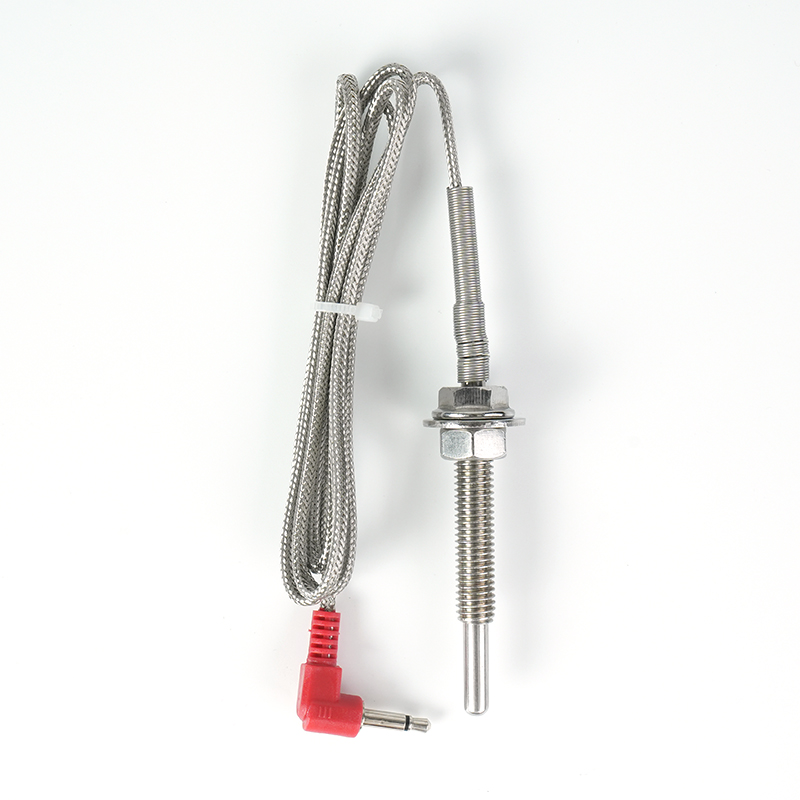
What Is a PT1000 Temperature Probe?
A PT1000 temperature probe is a type of resistance temperature detector(RTD)that uses platinum as its sensing element.The"PT"stands for platinum,while"1000"indicates that the sensor has a resistance of 1000 ohms at 0°C.
Unlike thermocouples,which generate a voltage based on temperature differences,a PT1000 temperature sensor measures temperature by detecting changes in electrical resistance.Platinum is used because it offers excellent stability,repeatability,and a nearly linear resistance-to-temperature relationship.
A typical RTD temperature probe consists of a platinum sensing element housed inside a stainless steel sheath,which protects the sensor from moisture,chemicals,vibration,and other environmental factors.
How Does a PT1000 Temperature Probe Work?
The working principle of a PT1000 RTD probe is based on the predictable change in platinum resistance as temperature changes.
Rt=R0(1+αT)
As temperature increases,the electrical resistance of the platinum element increases.When temperature decreases,resistance decreases accordingly.
Here's how the process works:
The platinum sensing element is exposed to the target environment.
Temperature changes cause the resistance of the platinum element to change.
The measurement circuit detects the resistance value.
The controller or transmitter converts the resistance into a temperature reading.
The temperature data is displayed,recorded,or used for process control.
Because platinum has highly predictable electrical characteristics,a high precision temperature probe can provide extremely accurate and repeatable measurements over a wide temperature range.
Key Features of PT1000 Temperature Probes
High Accuracy
One of the biggest advantages of a PT1000 temperature probe is its exceptional measurement accuracy.It provides precise temperature readings suitable for critical industrial and laboratory applications.
Excellent Stability
A platinum resistance temperature sensor maintains stable performance over long periods,making it ideal for continuous monitoring systems.
Wide Temperature Range
Most industrial temperature sensors based on PT1000 technology can measure temperatures ranging from-200°C to+600°C,depending on the probe design.
Strong Noise Resistance
Compared to lower-resistance RTD sensors,a PT1000 temperature sensor offers improved resistance to electrical noise and signal interference,especially when used with long cable runs.
Durable Construction
Many stainless steel temperature probes are designed to withstand harsh industrial environments,including moisture,vibration,and chemical exposure.
Applications of PT1000 Temperature Probes
Because of their reliability and precision,PT1000 temperature sensors are widely used across numerous industries.
Industrial Automation
Temperature monitoring is essential for manufacturing processes,machinery protection,and quality control systems.
HVAC Systems
A PT1000 temperature probe is commonly used for air conditioning,heating,and ventilation systems to ensure optimal environmental control.
Food Processing
Food manufacturers use RTD temperature probes to monitor cooking,refrigeration,and storage temperatures to meet safety standards.
Laboratory Equipment
Research laboratories rely on high precision temperature probes for experiments requiring accurate temperature control.
Medical Equipment
Many medical devices use PT1000 temperature sensors for monitoring and maintaining precise operating temperatures.
Energy and Power Generation
Power plants and renewable energy systems use industrial RTD sensors to monitor critical equipment and improve operational efficiency.
PT1000 vs pt100 temperature sensors
A common question is how a PT1000 temperature probe differs from a PT100 sensor.
| Feature | PT1000 | PT100 |
|---|---|---|
| Resistance at 0°C | 1000Ω | 100Ω |
| Signal Strength | Higher | Lower |
| Noise Immunity | Better | Good |
| Long Cable Applications | Excellent | Moderate |
| Measurement Accuracy | Very High | Very High |
The higher resistance of a PT1000 RTD probe reduces the influence of lead wire resistance,making it particularly suitable for applications with longer cable distances.
Advantages of Using a PT1000 Temperature Probe
Choosing a PT1000 temperature sensor offers several benefits:
High measurement accuracy
Excellent long-term stability
Fast response times
Strong resistance to electrical interference
Suitable for harsh industrial environments
Wide operating temperature range
Reliable performance in critical applications
These advantages make the PT1000 temperature probe one of the most trusted temperature sensing solutions available today.
FAQ
What does PT1000 mean?
PT1000 refers to a platinum RTD sensor with a resistance of 1000 ohms at 0°C.
How accurate is a PT1000 temperature probe?
A high-quality PT1000 temperature sensor can achieve accuracy levels of±0.1°C or better,depending on the sensor class and application.
Is a PT1000 better than a thermocouple?
For applications requiring high accuracy and stability,a PT1000 RTD probe is often preferred.Thermocouples may be better for extremely high-temperature environments.
Can PT1000 probes be waterproof?
Yes.Many stainless steel temperature probes are available with waterproof designs for use in liquids and outdoor environments.
Where are PT1000 temperature sensors commonly used?
They are widely used in HVAC systems,industrial automation,food processing,laboratories,medical equipment,and energy management systems.
